|
Tuesday, June 3, 2008
Math Awareness: Tactile Counting
An interesting idea occurred to me when we were driving home late a few nights ago. My throat was dry, so I pulled a box of Tic-Tacs out of my purse, shook some pieces into my hand (without turning on a light), and popped them into my mouth. As I rolled the candies around with my tongue, I began trying to count them to see just how many there were. The box that usually releases only one or two pieces with a good shake had instead given me a mouthful in the dark. One, two. One, two, three, four. No. One, two, three... One... two... three... four... FIVE? Yes, Five. A number that would have been very simple to identify with my eyes in a lighted situation was suddenly very difficult to count with just my tongue!
That experience set my mind to working overtime. How simple is it to count objects that I can see? How much more difficult is it to count objects that I can NOT see? The whole idea of blind counting made me consider the possibilities of math as a tactile experience. I have often carried coins in my jeans pocket and had to pull out a handful and look at them to select just one or two. If I was more adept at tactile identification, perhaps I could pull out only the coins I needed!
So here is my challenge for the day: experiment with tactile counting. I recommend trying it with fingers first, not letting your young children pop random objects into their mouths -- although that can be an interesting lesson for more advanced students (who are less likely to swallow). Expanding the awareness of number values to tactile skills and not just visual skills will allow the student to count quickly and easily by touch, even when seeing the objects in question is difficult or impossible.
I tested my own tactile counting skills by spreading a towel on the table, folded in half, with the fold farthest away from me. Then I closed my eyes and grabbed a large handful of goodies from my Activity Jar and inserted the objects between the layers of the towel. (The towel kept balls, marbles, and other small, round objects from rolling away.) Carefully keeping the upper layer of the towel in place to conceal the objects, I slipped my hands underneath it and began feeling the hidden treasures. To my surprise, there were a lot of things inside my towel -- many more objects than I expected to find.
I eventually pulled one hand out and began writing notes of what I had found, so I could record how many buttons and how many game tokens were included in this cache. I wrote down each basic category of items and used tally marks for the duplicates. When I was satisfied that I had sorted and counted everything successfully, I opened up the towel to check my accuracy. Oops. Close, but not perfect! I had miscounted the buttons: 14, instead of 15; but I had correctly identified five different types of game tokens: large, small, ridged, smooth, and cardboard (not plastic like the others). I had also correctly identified a coin as feeling different from the plastic game chips and accurately concluded (by touch only) that the coin was a penny, not a nickel or dime.
This was such a fascinating challenge that I repeated it several more times! Once, I purposely sorted out a large group of flat game tokens from my Activity Jar, some smooth and some with ridged edges. Placing those inside the towel, I attempted to sort them into two piles and count how many were in each pile. I accurately counted the ridged tokens, but I was off by two when I counted the smooth chips. My conclusion was that the thin, smooth chips could slip out of my hands unnoticed much more easily than the ridged chips could.
How about some other variations of this tactile math challenge?
- Blindfolded; count objects with your fingers
- Blindfolded; feel and count objects in a box on the floor with your toes
- Use several sizes of the same shape, such as a variety of coins
- Use a variety of shapes and sizes of different objects, such as buttons
- Count behind your back, feeling objects placed into your hands by a helper
- Feel objects placed inside a sack, box, or pillowcase (so you can't see them)
- For older or advanced students: tiny, hard candies in the mouth to count with the tongue. Tic-Tacs work well, since they are quite small and don't melt quickly.
The variations using toes or tongue develop tactile skills beyond the usual finger skills. Even a student who can quickly count or identify with finger-touches will find it a challenge to repeat the assignment with toes. I suggest starting with fewer than ten objects for toe-counting and using 3-dimensional objects, not flat items like coins.
For tongue-counting, be sure the student is not likely to choke or swallow the candies, and start with fewer than five small pieces. Keeping the head tilted forward can also prevent accidentally swallowing the candies. I cannot recommend putting non-edible objects in the mouth, nor do I suggest using anything larger than a plain M&M candy. Hard candies work better for this experiment than do soft, chewable candies. Tic-Tac candies are ideal: small and solid.
One more variation would be to turn this into an auditory activity by counting sounds. Conceal your hands behind a large book or similar partition and tap quickly several times, while your student attempts to count how many taps he hears. A more complex version would involve listening to music and counting notes, beats, or instruments heard. Take this activity outdoors and listen for vehicles, horns, or bird songs.
Math is primarily a visual task, but stretching our abilities and learning to sort and count with our other senses will bring the benefits of increased skills and a related increase in thinking power. And just imagine the fun of impressing your friends with your ability to count the change in your pocket without looking!
Posted by Carolyn M @ 4:01 PM |
5 comments
Thursday, May 1, 2008
Top 10 Ways to Salvage an Interrupted Day
You had finally found your homeschooling "groove." Lessons were zipping along, your students were working like well-oiled machines, and then it happened: something came along that broke that wonderful, systematic rhythm. You may have known it was on the calendar, but that still didn't prevent it from upsetting your entire homeschooling apple cart. Now you feel as though your students may never regain their previous momentum.
Rather than taking an entire day off, you may be able to salvage the remaining portion of an interrupted day and manage to keep enough of the energy that the interruption is merely an insignificant blip on your radar. Here are several ways to complete "school" when the normal routine has been interrupted by doctor's appointments, a minor family crisis, a field trip or co-op class, a funeral, or any number of other inconvenient breaks. These measures may also help you get through a bad weather day, a not-feeling-so-well day, or a we-really-overdid-it-yesterday day. (Tip: In the case of a minor family crisis that lands you and your loved ones in the local Emergency Room, try to redeem the experience as an impromptu field trip: encourage observational skills and appropriately timed Q & A sessions about what the medical professionals are doing, so that your students gain knowledge about other career fields along with the immediate medical attention. Plus, it can also help focus children's minds away from pain, suffering, and generally frightening situations.)
1. Half-Lessons--Scheduled interruptions (such as dentist appointments or well-child check-ups with the doctor) can allow you to plan ahead for a half-day of lessons. Shorten each subject's work load to a portion of its regular size and zip through your schedule in record time. Your students will know they have covered the usual subjects, and the results of the faster pace can spur your students into working more quickly on "normal" days, too.
2. Consumer Math--Shopping is necessary for every household, so incorporate it into your curriculum by posing price comparisons to your students. Show them how to read the labels for ingredients, size of contents, or any other vital statistics, and then help them compare brands and sizes to determine the best value for your family's needs. Yes, this can make shopping take longer, so I do not recommend doing this with every item when you are already pressed for time or when you are restocking a nearly bare pantry.
3. Life Skills--Sewing on buttons, hemming a skirt, ironing shirts, following a recipe for cooking or baking, washing windows, folding the laundry, cleaning out a closet, organizing the kitchen "junk" drawer, or sweeping out the garage--all are vital skills for life that can redeem the productivity of an interrupted school day.
4. Phys-Ed--Let 'em run. Dust off the bicycles, roller blades, baseballs, or jumpropes. Everyone needs a physical break now and then, and younger children need them even more often. The physical exercise relaxes their tired muscles and gives their brains "processing" time. You may be surprised at the creative ideas that are hatched during this "down" time.
5. Snuggle Up & Read Day--Grab your favorite books and head for the sofa. Read to each other or just let each person read his own book, side by side. Snuggle up with warm blankets and thick, warm socks. I love soaking in the warmth from a sunny window when the winter weather is too cold to enjoy venturing outdoors.
6. Craft Day--There is something infinitely satisfying and therapeutic about creating things with your own hands. Whether you make silly masks with paper plates and colored markers or intricately detailed ornaments for your next Christmas tree, the time spent with your children provides an opportunity to talk together, create together, and giggle and laugh together. Check hobby stores for ready-made craft kits if you need help getting started.
7. Cooking or Baking Day--Make an extra-large batch of cookies or soup and freeze the extra for use on your next too-rushed-to-cook day. Dicing onions, celery, or carrots to freeze for future use in soups or casseroles is a time-saver as well as an opportunity to work and talk together with your children.
8. Game Day--Play your favorite board games. Combine the pieces from several games and invent a new game. Don't keep score, but focus on the aspects of strategy and sportsmanship, instead of on winning and losing. Show lesser-skilled students how to plan ahead and think through their moves to help them strengthen their abilities for next time.
9. Nature Study--Take a walk. Sit under a tree. Watch and listen to the birds. Weed the flower bed. When the disruptions of life have intruded upon the security of your routine, regain control by surrounding yourselves with the peace and solitude of God's handiwork. It can be even more refreshing than a nap!
10. Video Day--Watch a favorite movie. Watch a new movie. Watch an old movie. Use technology to your advantage and pause the movie at strategic moments to discuss why the characters act the way they do or discuss how the plot would have changed if a key character had chosen another option at a crucial point.
Life Happens. I repeat that often to explain what has disrupted my formerly-planned day. When Life happens to your schedule, use it to your advantage to teach valuable life lessons. And remind yourself that children sitting in orderly rows in a sterile classroom are missing out on the inevitable spontaneity that is Life.
For further encouragement on the topic of interrupted days, missed lessons, and messed-up schedules, see: A Day Without Lessons, Reschedule, Refocus, Regroup, and Sick Days, Snow Days, and Other Interruptions
Posted by Carolyn M @ 5:09 PM |
1 comments
Tuesday, April 22, 2008
Carnival of Homeschooling, April 22
Spring has been taking a long time to appear here in central Iowa, but things certainly are blooming heartily at the Carnival of Homeschooling! This week's collection is huge, which simply means that everyone will find something encouraging there! Many thanks to Dana at Principled Discovery for her valiant efforts in hosting this Carnival!! Dana's theme is "The Homeschool Bag Lady," in honor of all the bags o' stuff we moms tote around, both literally and metaphorically.
Posted by Carolyn M @ 10:29 AM |
0 comments
Monday, April 14, 2008
Top 10 Benefits of Homeschooling with Grace
No, Grace is not my name, nor is it my daughter's name. "Homeschooling with Grace" refers to making homeschooling a real possibility for you. If your mental image of homeschooling (before you began) was much different from what your homeschooling reality has become, perhaps you need a dose of Grace. Sit back, relax, and lower your standards just enough to allow yourself to breathe easily again as we look at the Top 10 Benefits of Homeschooling with Grace.
10. You can provide your students with as much time as they need to truly understand a concept, and you can allow your students to skip redundant portions of lessons they have already learned. [Grace is patient, but Grace also recognizes achievement.]
9. You meet other homeschooling families who do things differently than you do, and you smile, knowing that all homeschoolers are unique. [Grace appreciates the differences in life.]
8. Every member of the family relaxes, knowing that Grace bestows forgiveness, second (and third and fourth) chances, and hugs when you need them. [Grace understands, and Grace loves anyway.]
7. You give up "flying under the radar" to avoid attracting attention as a homeschooling family and boldly traipse through parks, stores, and other public areas between the hours of 8:00 a.m. and 3:15 p.m., knowing that anyone foolish enough to inquire why your children are not "in school" will have to endure a barrage of giggles, several quippy answers from each child, and at least 3 recitations from recent history and science lessons. [Grace accepts Life as a good teacher.]
6. You redefine a "clean" house to mean one that looks lived in but can still be occupied without fear of actually contracting any truly scary diseases. [Grace knows that perfection is unattainable on this side of Heaven.]
5. You no longer cringe at the thought of friends dropping by unannounced, realizing that they are more interested in sharing 5 minutes of conversation with another grown-up than in performing a white-glove inspection of your bookshelves. [Grace prefers people to things.]
4. You realize that no one who really loves you will care if the breakfast dishes are still in the sink when you start supper. Or that once in a while last night's pizza boxes can be found on the coffee table. At least the leftovers are all gone... thanks to the family dog. [Grace knows when you need a break.]
3. The thought of seeing your family pictured on the cover of a homeschooling magazine would mean that chore-boot footprints and mud stains are being featured in that issue's Art Corner. [Grace knows that Life is not tidy.]
2. You lower your expectations of homeschooling to include only those things your students might actually be able to accomplish in this lifetime. [Grace does not expect the impossible.]
And finally, the Number One Benefit of Homeschooling with Grace is:
1. Grace. Just when you think you've messed up everything beyond all hope of repair, God gives you the Grace to start fresh and try again. [His mercies are new every morning--Lamentations 3:22-23]
Posted by Carolyn M @ 1:33 PM |
11 comments
Thursday, April 10, 2008
Guilt-Free Homeschooling STORE -- Now Open!
Observant readers may already have spotted the new link in the right sidebar: Guilt-Free Homeschooling STORE! This is one more proof that the absence of recent blog posts does not mean I am lounging about, eating bon-bons, or worse -- leaving struggling homeschoolers to fend for themselves. On the contrary, I am very pleased to be able to provide you with even more GFHS resources, starting with two that you can purchase for use when the computer isn't so handy.
NOW AVAILABLE in the GFHS STORE--
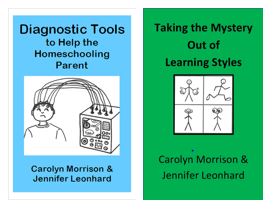
Diagnostic Tools to Help the Homeschooling Parent For those who may be missing the links to our (formerly-on-the-internet) quizzes (What Type of Homeschooler Are You? and What Is Your Learning Style?), the quizzes are now available in our new book, Diagnostic Tools to Help the Homeschooling Parent, along with pages and pages of supplemental information to help you analyze, evaluate, and remedy your daily homeschooling difficulties. This book is not for everyone, but if your students are struggling to make academic progress, it is definitely for YOU!
Guilt-Free Homeschooling Planner Can't find a planning book that fits your unique homeschooling situation? We are happy to announce the Guilt-Free Homeschooling Planner, an innovation in homeschooling planners, offering multiple planning modules -- not a one-size-fits-all, our-way-is-the-only-way record book. GFHS Planner modules work for the large family or the single-child family, plan-ahead organizers or record-after-the-fact less-organized types. Choose from 8 versatile modules to create the planning notebook that will work for you!
P.S. Our experience at the Chicago-area InHome Conference was great. Thanks to all of you who popped in to say, "Hello, I'm one of your blog readers!" and WELCOME to the new friends we made in our workshops!
Posted by Carolyn M @ 3:33 PM |
3 comments
Monday, March 3, 2008
Conference Reminder
This is just a quick reminder that I will be speaking in the Chicago area this weekend (March 7-8th) at the InHome Conference. My workshops will be Friday morning (What Type of Homeschooler Are You?), Friday evening (Losing the Guilt), and Saturday morning (Taking the Mystery Out of Learning Styles). Seating is limited, so register now and come early for a good seat! Bonus--Guilt-Free daughter and co-blogger/co-author, Jennifer, will also be there! If you are able to attend, please introduce yourself to us as a Guilt-Free reader--we hope to see you there!
Attendees of this conference will get the first official opportunity to purchase our brand-new book, Diagnostic Tools to Help the Homeschooling Parent. Break free from your homeschool struggles, measure your homeschooling efforts, and discover the best materials and methods for effective and unlimited learning.
The Guilt-Free Homeschooling Planner will also be available for the first time. An innovation in homeschool planning books, the GFHS Planner uses a modular concept that allows you to custom-design a unique planning notebook to fit your specific needs.
Posted by Carolyn M @ 11:17 AM |
4 comments

|